Measuring Local Flow Velocity in Immersion Cooling Systems

Paul Roger Leinan, Loïc Duffo, Halvard Thon | SINTEF | June 23, 2026
In immersion cooling systems, local flow velocity is an important factor for both system performance and component safety. It affects how efficiently the dielectric cooling fluid removes heat from server blades, and it can vary significantly between different regions of the tank and within the narrow passages inside each server blade.
These local velocity fields can be investigated using direct measurements or computational fluid dynamics (CFD). CFD is a powerful design tool, but simulations of complete or even selected parts of the immersion tanks and server assemblies can be computationally demanding, as well as requiring validation against known, similar cases. The geometry includes many narrow passages, obstructions, cables and complex flow paths, making detailed models costly to build and run. Direct local measurements are therefore attractive, both for optimizing tank and blade geometry during design and for monitoring flow conditions during operation.
One challenge is that the relevant velocities can be very low - from a few millimeters per second to a few centimeters per second. Another challenge is the liquid environment itself: sensor materials must be compatible with the immersion fluid, while the measurement must account for changing fluid temperature, because temperature affects both the sensor response and the fluid properties.
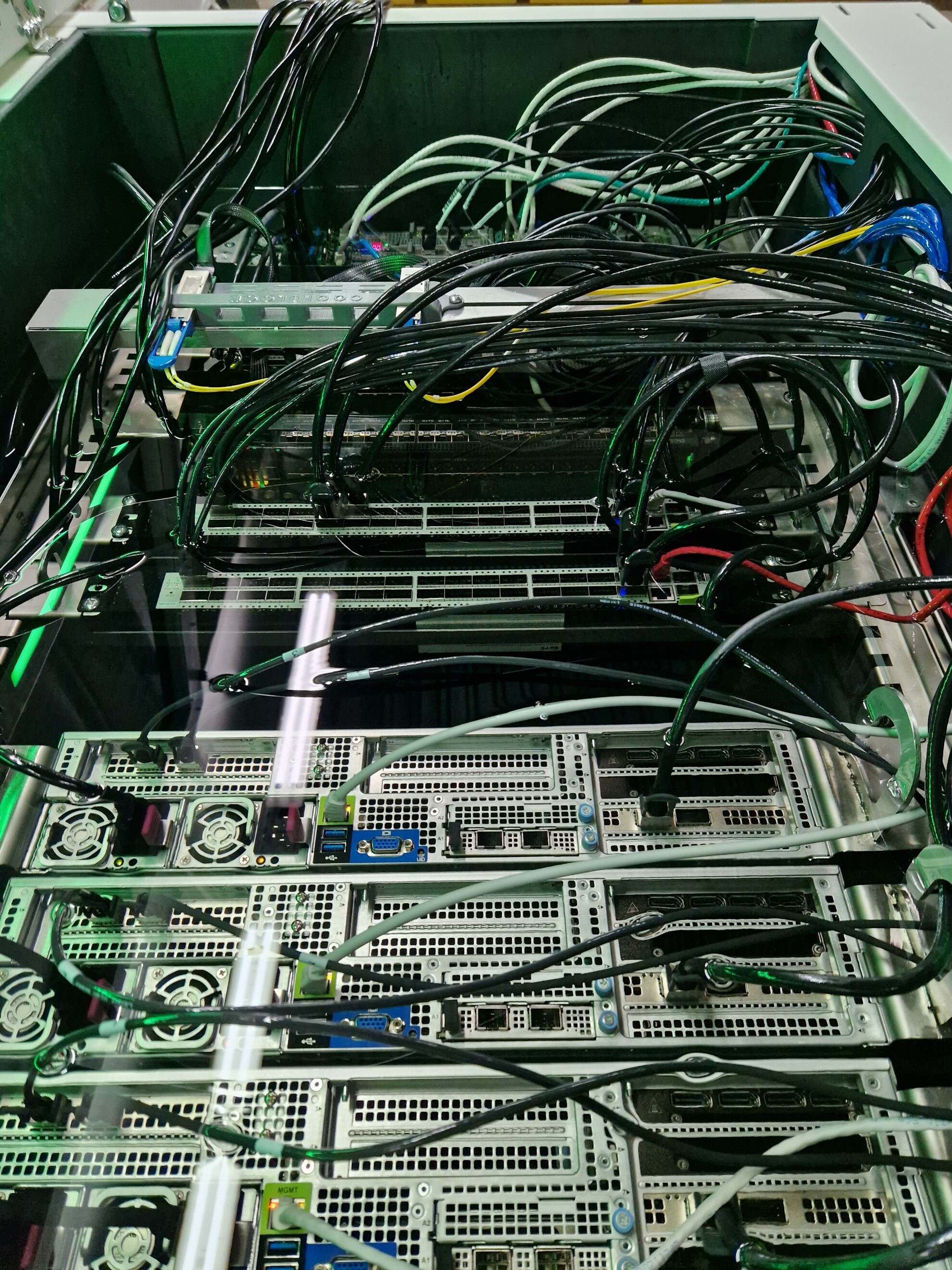
Looking down into an immersion cooling server tank.
Thermal anemometry as a compact measurement method
A variety of techniques can be used to measure flow velocity, including ultrasonic or laser Doppler methods, particle image velocimetry, Pitot tubes, small propellers, cantilever-based sensors and thermal anemometry. Several commercially available miniaturized low-flow instruments exist [2], but the majority of these (usually a small pipe with sensory equipment that the liquid must flow through) are developed for microfluidic setups. Such instruments are generally not suited for measurements in immersion tanks and servers where the objective is to measure the velocity of freely flowing liquid at specific locations with minimal disturbance to the flow.
A potential approach for this application is miniaturized thermal anemometry, such as the nano-CTA sensor from Surrey Sensors [1]. These sensors infer velocity from convective heat transfer: a small, heated element loses heat to the passing fluid, and the required heating power to keep a desired temperature changes with flow speed. With calibration for the relevant fluid and temperature range, the measured heat-transfer signal can be converted into a local flow velocity.
The small sensor size is also a key advantage. It makes it possible to place measurement points close to, or potentially inside, server-bladed flow paths where larger instruments would disturb the flow or simply not fit. The method is also well-suited for comparing design variants and for validating CFD models in regions where the predicted velocity field is uncertain.
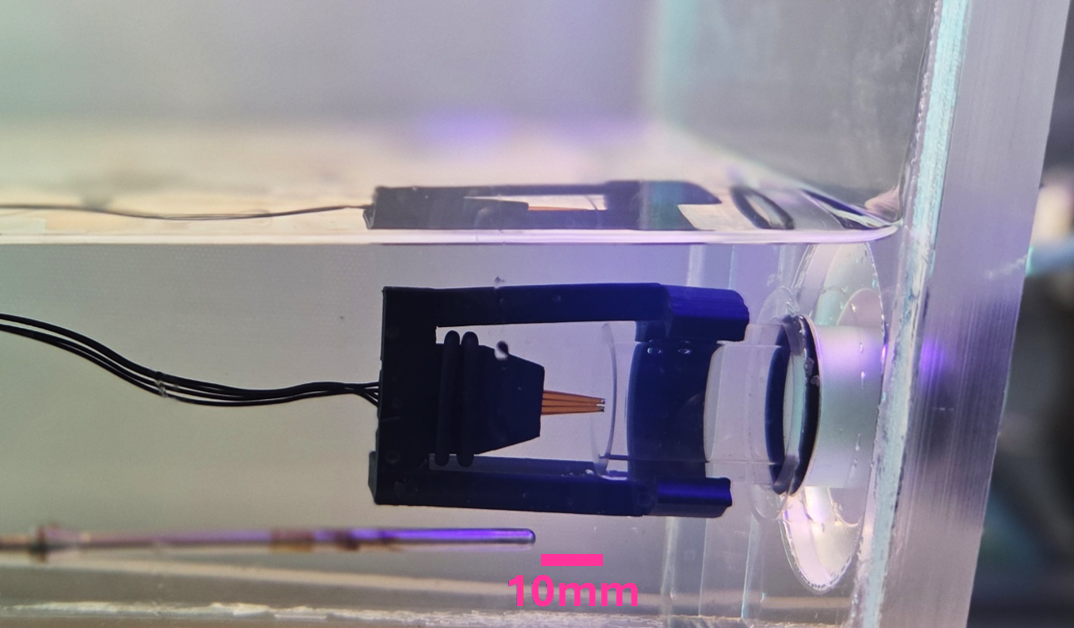
Miniaturized thermal anemometry sensor (nano-CTA sensor, Surrey Sensors [1]) used for local velocity measurement in an immersion-cooling test setup. The scale bar indicates 10 mm.
Tests at SINTEF
SINTEF has tested a miniaturized thermal anemometry sensor in the context of immersion cooling. A custom test setup was built to generate controlled liquid-flow velocities in a relevant low-speed range and at relevant operating temperatures. The tests indicate that the measurement technique is promising for immersion-cooling systems. Potential uses include design optimization, validation of CFD simulations and online monitoring of local flow conditions. Further work focuses on calibration robustness, temperature compensation, long-term stability and sensor placement strategies that minimize flow disturbance while providing useful information for immersion system design and control.
References
[1] nano-CTA, Surrey Sensors, https://www.surreysensors.com/
[2] Cavaniol, C., Cesar, W., Descroix, S., & Viovy, J.-L. (2022). Flowmetering for microfluidics. Lab on a Chip, 22, 3603-3617. https://doi.org/10.1039/D2LC00188H