From One Litre to 500 kWh: Scaling Up Heat Storage for the MODERATOR Pilot

COWA THERMAL SOLUTIONS AG | September 16, 2026
Last year we tested our phase change material in one-litre samples. Today, 40 full-size Compact Cells holding more than ten tonnes of storage are ready to capture waste heat at a data centre in Greece.
In July 2025, we introduced the COMPACT Cell on this blog: a thermal storage unit filled with a phase change material (PCM) that melts at low temperature, designed to store waste heat from data centres. At that point, our tests ran at the one-litre scale, checking that the material stays stable over many heating and cooling cycles.
Fifteen months later, the picture looks very different. The storage system for the MODERATOR pilot has been built, tested, and is getting ready to travel to Thessaloniki.
|
40 Compact Cells |
≈ 500 kWh nominal storage capacity |
> 1,000 stable charge/discharge |
> 10 t of storage in one container |
Why scale up step by step?
A material that behaves well in a beaker does not automatically behave well in a 260 kg storage unit. Heat has to travel through the material, fluid has to flow evenly through the heat exchangers, and every unit has to perform the same as its neighbours. So we scaled up in stages, and learned something at each one:
1. One-litre samples: proved that our PCM48, which melts at around 48 °C, stays stable over more than 1,000 charge and discharge cycles.
2. A single Compact Cell: confirmed how much heat one full-size unit stores (10–13 kWh) and how fast it can take heat in and give it back.
3. Six cells connected together: showed that several cells can be linked in series and in parallel while sharing the flow evenly. The same arrangement runs today in one of COWA's field installations.
4. The full 40-cell system: the storage for the MODERATOR pilot, with a nominal capacity of about 500 kWh.
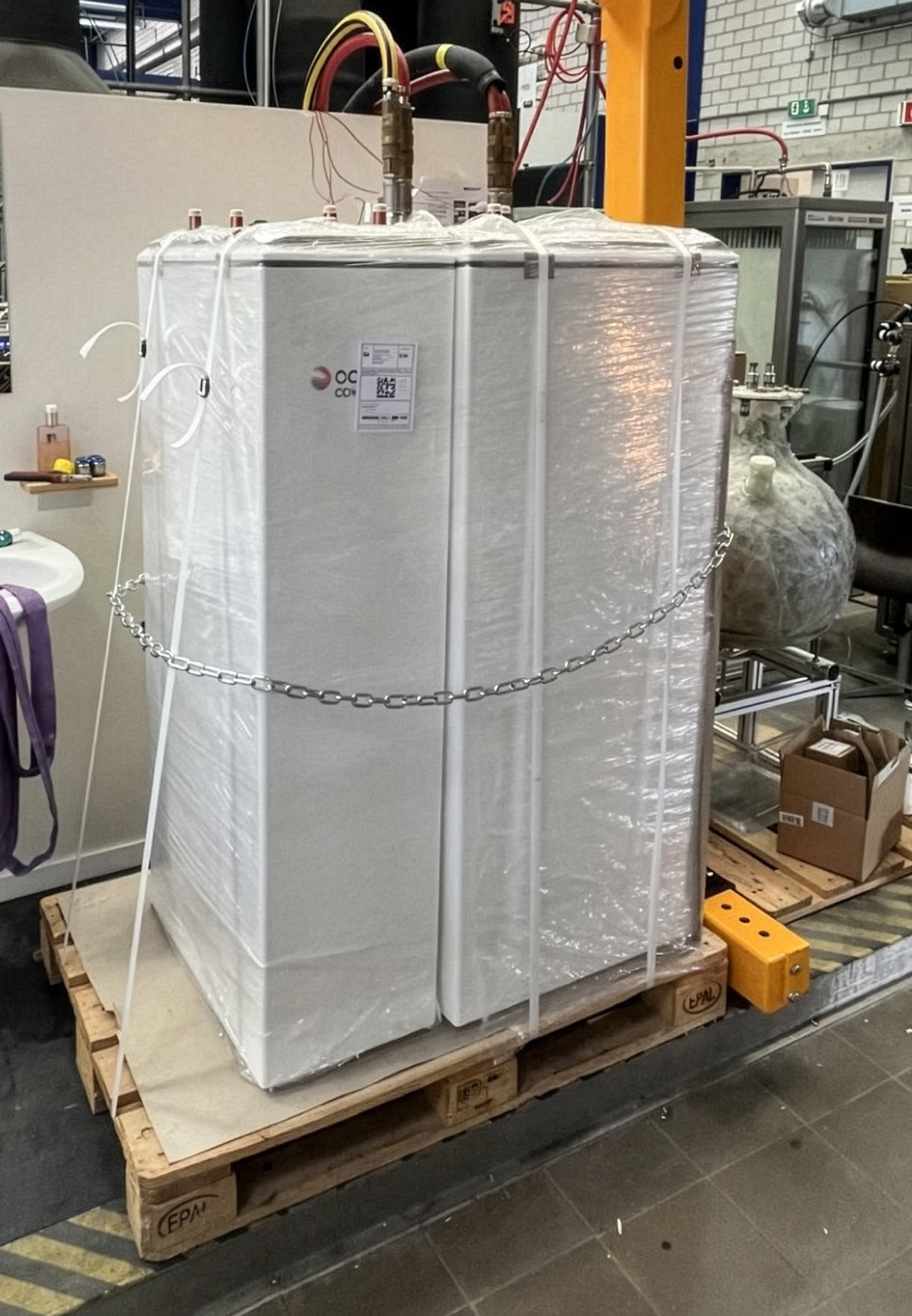
Compact Cells on the test rig at HSLU.
What is inside a Compact Cell?
Each cell measures 1.4 × 0.6 × 0.34 m and weighs 262 kg. The PCM is filled directly around a finned-tube heat exchanger inside the cell. This keeps the heat path short and the design simple.
The melting point was chosen to suit the data centre. Immersion-cooled servers deliver warm fluid at up to about 60 °C, hot enough to melt the PCM and store the heat. When the heat is needed, the PCM solidifies again and releases it at around 45 °C.
Tested at HSLU
Before leaving Switzerland, the cells went through a test programme at the Lucerne University of Applied Sciences and Arts (HSLU). The team charged and discharged them at different power levels. Per cell, they took in heat at 2.5–10 kW and released it at 20–40 kW.
In other words, the storage charges slowly and steadily from the data centre's waste heat, then can release it much faster when a building or process needs it.
40 cells, one system
In the pilot, the 40 cells are arranged in five parallel rows of eight cells in series. The series connection lets the water heat up step by step as it passes from cell to cell. The parallel rows share the flow, keeping pumping power low.
What's next?
The cells will be shipped in late fall to the SYNAPSECOM data centre in Thessaloniki, Greece. There, they will be connected to the MODERATOR immersion cooling system together with HYSYTECH and SYNAPSECOM.
The first charge and discharge cycles are planned for late 2026. The goal is to show that heat from a data centre can be stored and reused instead of being released into the air. We will report back once the storage is running.